
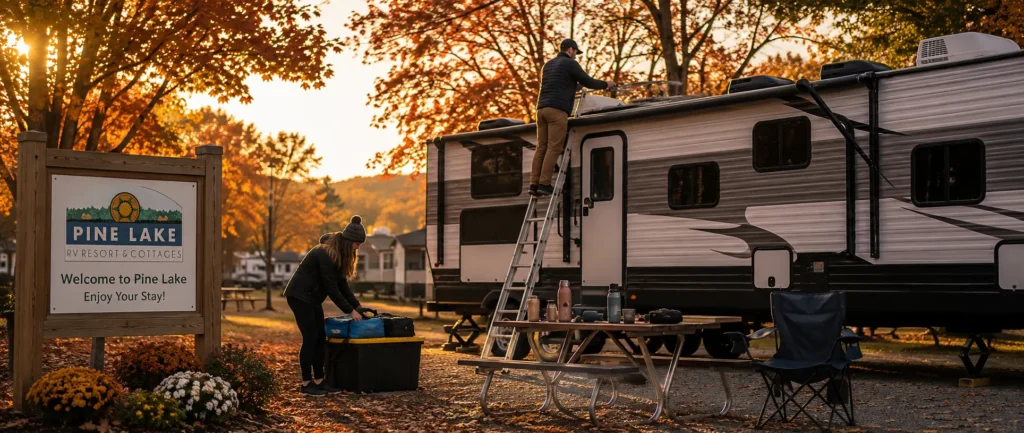
Most RV problems in fall don’t show up in fall. They show up in December, when a line you forgot to drain finally splits, or next spring, when a battery you left in a cold bay won’t hold a charge anymore. The prep work matters more this season than any other because the mistakes are slow and you won’t feel them until you’re already paying for them.
Here’s what actually needs attention before a fall trip and why.
Start with the roof, not the tank
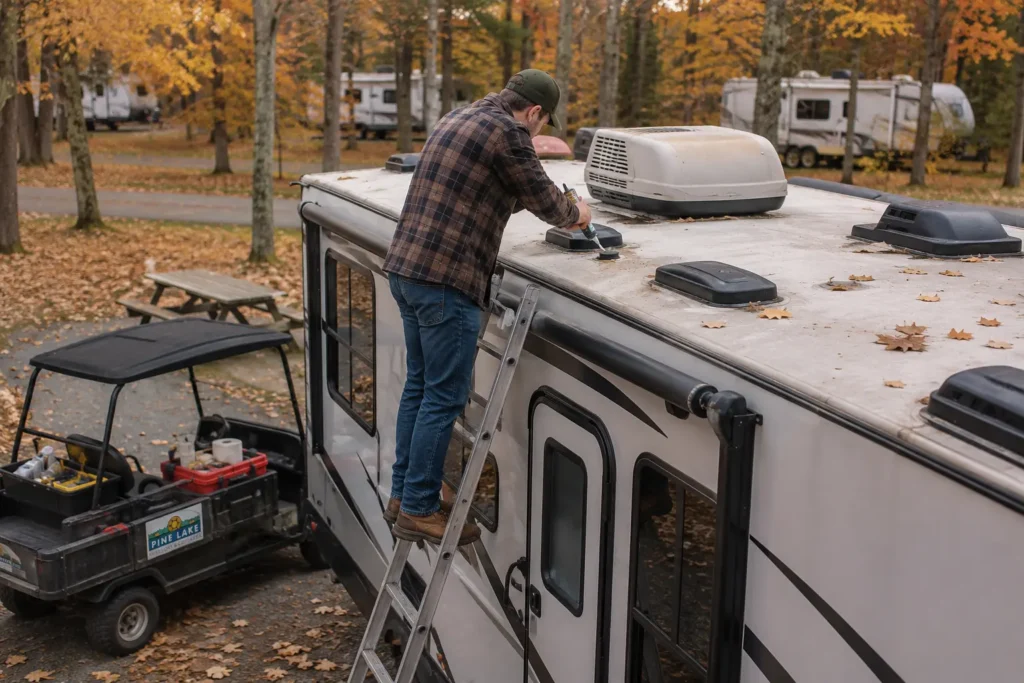
Everyone thinks about water systems first. Start higher. Fall storms in the Northeast bring wind-driven rain and a roof seam that held fine all summer can start leaking the first time water hits it sideways instead of straight down.
Walk the roof if it’s safe to do so, or check from a ladder with a flashlight. Look at every seam around vents, the AC unit and antenna mounts. Sealants like Dicor shrink and crack over a season of UV exposure, so a hairline crack you’d ignore in July becomes a slow drip once fall rain starts sitting in it longer. Recaulk anything questionable now, while it’s still warm enough for the sealant to cure. Most self-leveling sealants need temperatures above 50°F to set right and that window closes fast once real fall weather moves in.
What should actually be on your fall packing list?
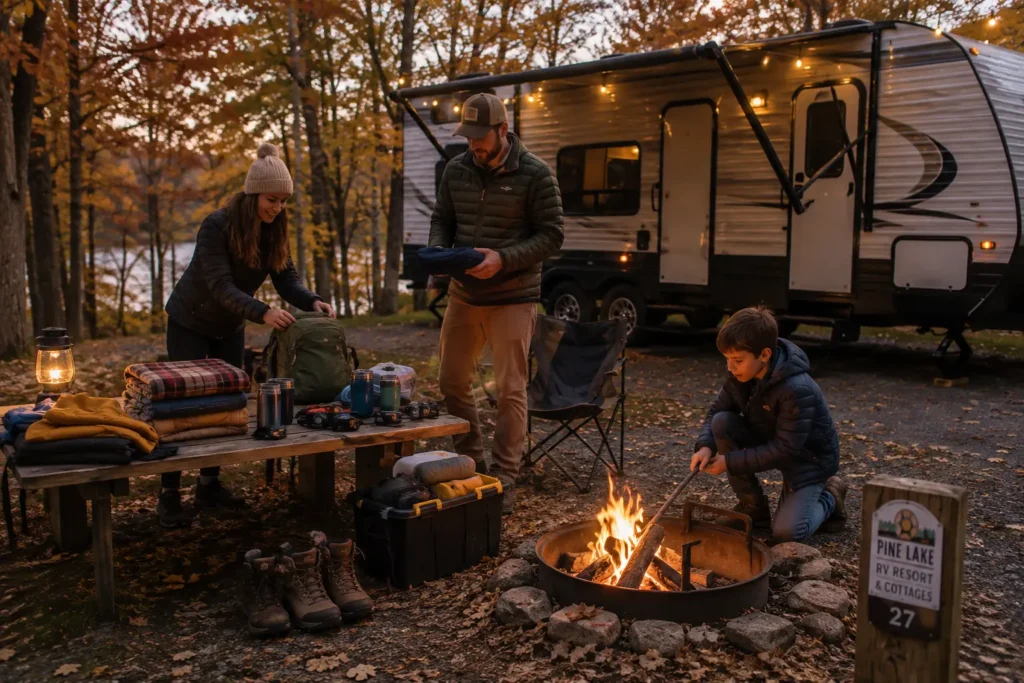
The gear list changes more than people expect. Here’s what actually earns a spot in the rig for a fall trip, beyond just a heavier coat.
Layers
A base layer, a mid layer, and a wind-resistant shell adjust to a 30-degree morning and a 60-degree afternoon better than a single bulky jacket. Fall temperatures in Central Massachusetts can swing 20 to 30 degrees between sunrise and midafternoon, so one heavy coat leaves you either too hot at noon or too cold at 7am. Merino wool or synthetic base layers dry faster than cotton if you end up caught in the rain. Pack at least two full layering sets so you’re not stuck rewearing something damp the next morning.
Headlamp
Daylight shortens by roughly two to three minutes a day through fall, and it adds up fast. A trip that started with 7pm sunsets can end with 5:30pm sunsets by late October. A headlamp keeps your hands free for setting up camp, cooking, or walking the dog after dark, which a regular flashlight doesn’t. Bring backup batteries, since cold weather drains them faster than you’d expect. A small lantern for the picnic table area is worth the extra space too.
Extra blankets
Worth packing even if your furnace works perfectly. Backup warmth costs nothing to bring and matters if anything trips overnight, whether that’s a tripped breaker, a furnace that cuts out, or a night colder than the forecast predicted. Wool blankets hold heat better than synthetic ones if you’re relying on them as a genuine backup rather than just a throw. Keep at least one per person in the rig itself, not folded away in a storage bin you’d have to dig through at 2am.
Rain gear
Not just water-resistant. Fall weather swings harder than summer weather does, and a light drizzle can turn into steady rain without much warning. A real waterproof shell, not a wind-resistant jacket that only repels light mist, keeps you actually dry instead of just less wet. Pack rain pants too if you’re planning to hike, since wet jeans in 50-degree weather cool you down fast. A packable poncho is a decent backup for anyone in the group who forgets their jacket at the site.
Dry socks
Wet feet ruin a trip faster than cold air does. Pack more pairs than you think you need, since fall ground stays damp longer than summer ground after a rain, and one wrong step into a puddle can end your dry-sock supply for the day. Wool socks hold warmth even if they get slightly damp, which cotton doesn’t. Keep one dedicated dry pair sealed in a bag just for sleeping, so you’re never tempted to use it early in the day.
Hat and gloves
Most of your body heat escapes through your head and hands, so a warm hat and a pair of gloves do more for comfort than an extra layer on your torso. Pack a set for each person, plus a spare pair of gloves in case one gets wet during setup or a hike. Fleece-lined options work well for most fall temperatures without the bulk of full winter gear. Keep them somewhere easy to grab, like a door pocket, rather than buried in a bag.
Firewood
Worth bringing your own or confirming it’s sold on-site, since fall evenings drop fast enough that a fire stops being optional. Many resorts restrict bringing in outside firewood to prevent spreading pests, so check the site’s rules before you load up the truck. A few fire starters or dry kindling help if the wood on-site has picked up any dampness from fall rain. A basic fire tool set makes managing it easier once it’s actually going.
Space heater
A small, RV-safe electric space heater can take the edge off a cold morning without running the furnace and propane down. Only use one rated for indoor use in an enclosed space, and never leave it running unattended overnight. Check that your site’s electrical hookup can handle the extra draw alongside everything else running in the rig. Treat it as a backup to the furnace, not a replacement for testing the furnace before you leave.
Insulated mug
A small comfort item, but a real one. Coffee or tea stays warm through a cold morning at the picnic table instead of going lukewarm in five minutes. It’s an easy thing to forget packing and an easy thing to actually miss once you’re sitting outside at 45 degrees. Worth keeping one dedicated to the RV rather than borrowing from the kitchen at home before every trip.
How do I keep my RV water lines from freezing in fall?
New England nights start dropping toward freezing well before the daytime highs feel like fall has arrived. That mismatch catches people. A 55-degree afternoon doesn’t mean the overnight low won’t dip enough to freeze an exposed line.
A few things worth doing before any trip where overnight temps might approach freezing:
- Know your rig’s weak points. Exterior hoses, the city water inlet and any line running along an outside wall freeze first. Insulate them or plan to disconnect at night.
- If you’re staying somewhere without heated hookups, night-draining your fresh water hose becomes routine once temps get close to freezing, not just when they cross it.
- Heat tape on exposed lines is standard practice at a lot of Northeast RV sites once October really sets in. A plug-in heat tape kit from any RV supply store solves this for under $30 if your site doesn’t have it built in.
- Skirting isn’t only for winter. Even light skirting around the underbelly slows heat loss on cold nights and protects your tanks from wind chill, which drops the effective temperature more than the thermometer suggests.
Don’t wait for a hard freeze warning to start thinking about this. First frost in Central Massachusetts typically lands somewhere in mid-to-late October, but the nights that damage plumbing usually arrive before the frost does, cold enough to freeze standing water in an exposed line, not cold enough to leave frost on the grass yet.
Do you need extra battery capacity for fall camping?
Yes. Cold weather is brutal on battery capacity. A lead-acid battery loses a meaningful chunk of its usable capacity as temperatures drop and if you’re running furnace fans, extra lighting for shorter days and maybe a space heater, you’re pulling more power exactly when your battery has less to give.
Check terminals for corrosion before you leave. Test the charge with a multimeter instead of trusting a dashboard indicator. If you’re camping somewhere without full hookups, bring more battery capacity than you think you’ll need, not less.
How does daylight savings affect camping in fall?
This one’s easy to underestimate. Through fall, daylight shrinks by roughly two to three minutes a day, which sounds small until it adds up to nearly an hour of lost daylight over two weeks. Trips planned logic in September don’t work the same way by late October.
Pack a real headlamp, not just a phone flashlight. Exterior lighting for hookups, leveling and finding your way to the bathhouse matters more once it’s fully dark by 6 or 6:30. If you’re arriving at a new site, build in a buffer for setup before sunset. Fumbling with sewer hoses in the dark is nobody’s idea of a good first night.
Fall camping meals
Cold-weather cooking should lean toward one-pot meals that double as a small heat source in the process. Chili, stew, anything on a stove for 30-plus minutes warms the rig a little as a side effect. Cast iron holds heat longer than most cookware, which matters more outdoors in fall than it does in summer.
If you’re grilling, plan for shorter daylight windows and keep a backup indoor cooking option ready in case rain moves in on your mid-meal.
For first-time fall campers
If this is your first cold-weather trip, don’t overcomplicate it. Test your furnace before you leave, not on night one at the site. Bring more layers than you think you need. You can always take one off, but you can’t add what you didn’t pack. And check the specific site’s policy on generator hours and hookup type before assuming full hookups are standard, because not every fall site has them.
Book your weekend at Pine Lake
Fall camping in New England rewards preparation more than any other season. The foliage is worth it, the crowds thin out, and the trails feel like they belong to you. Pine Lake RV Resort & Cottages, at the junction of I-84 and I-90 in Sturbridge, offers full hookup sites if you’d rather skip the night-draining routine and let the resort’s infrastructure handle the cold-weather logistics for you.
Whether you’re headed there or somewhere else, the checklist above works the same. Fall camping isn’t harder than summer camping. It’s just less forgiving of skipped steps.
FAQs
Do I need to fully winterize my RV for a fall camping trip?
Not usually. Full winterization, with antifreeze run through every line, is for storing an RV over winter, not for an active fall trip. If you’re still using the RV and running the furnace, night-draining your lines or using heat tape on cold nights is normally enough. Full winterization only makes sense once the trip is your last one of the season.
How far in advance should I start prepping for a fall trip?
A week or two ahead is enough for most of this list. That gives you time to test the furnace, check the battery, and order a replacement part, like a propane hose or a headlamp, without scrambling the night before you leave.
At what temperature do RV water lines actually freeze?
Water freezes at 32°F, but exposed hoses and thin lines can freeze even when the daytime forecast looks mild, since overnight lows drop well below the afternoon number. Once nighttime temperatures start flirting with freezing, treat your water system as at risk.
Is fall actually a good time to go RV camping?
For a lot of RVers, it’s the best stretch of the year. Crowds thin out after Labor Day, sites are easier to book, bugs mostly disappear, and the foliage is worth the trip on its own. The trade-off is a bit more prep than a summer weekend, which is exactly what this checklist covers.
Do RV resorts stay open through the fall?
It depends on the property. Some close as early as October, especially ones without full hookups or winterized bathhouses. If you’re planning a trip into late fall, confirm the resort’s actual closing date before you book instead of assuming it runs the same schedule as summer.